
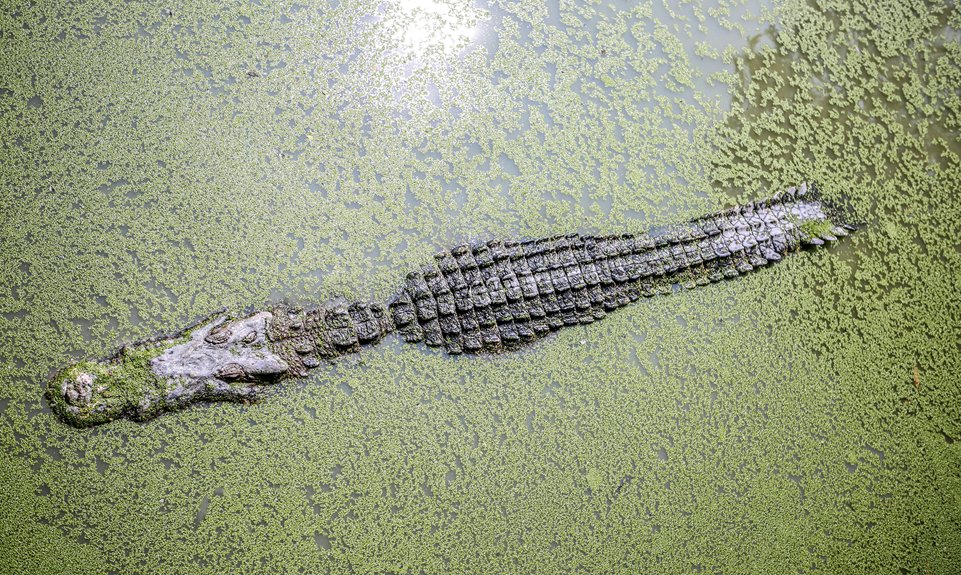
Lake management programs often struggle to control HABs because they focus mainly on reducing external nutrient inputs without fully addressing internal phosphorus cycling and sediment release. Human activities like agriculture and urban runoff exacerbate nutrient loading, while climate change intensifies stratification and hypoxia, weakening natural resilience. Consequently, systems become more susceptible to harmful blooms despite interventions. Understanding these complex interactions reveals why current strategies fall short and highlights the need for more integrated, adaptive solutions to safeguard lake health.
Understanding Eutrophication and Its Role in Algal Blooms
Eutrophication occurs when nutrient levels in a lake, particularly nitrogen and phosphorus, increase beyond natural levels, stimulating excessive algal growth. Central to this process is phosphorus cycling, which regulates the availability of phosphorus within the aquatic system.
As phosphorus accumulates in sediments, disturbances or chemical changes can release it back into the water column, fueling algal succession. During early stages, nutrient enrichment promotes rapid proliferation of phytoplankton, shifting the community composition.
This algal succession often favors fast-growing, bloom-forming species, which outcompete native aquatic plants. The continuous input and internal recycling of phosphorus sustain these blooms, disrupting ecological balance.
Understanding the intricacies of phosphorus cycling helps explain how nutrient overloads drive persistent algal growth. Consequently, eutrophication not only elevates algal biomass but also triggers a cascade of ecological changes, leading to hypoxia and habitat degradation that threaten overall lake health. Biological water cleaning techniques can be employed to address these issues by targeting the root causes of nutrient enrichment and restoring ecological balance.
How Human Activities Accelerate Nutrient Loading in Lakes
Human activities considerably accelerate nutrient loading in lakes by introducing excessive amounts of nitrogen and phosphorus through various pathways. Phosphorus runoff from agricultural fertilizers is a primary contributor, especially when heavy rains wash these nutrients into water bodies. The widespread use of agricultural fertilizers increases the concentration of bioavailable phosphorus, which readily stimulates algal growth.
Additionally, urban runoff containing lawn fertilizers and sewage effluents further compound nutrient input. These inputs overwhelm natural filtration processes, leading to elevated nutrient levels that promote eutrophication. The acceleration of nutrient loading disrupts aquatic ecosystems by favoring harmful algal blooms (HABs), which can produce toxins detrimental to aquatic life and human health.
The spatial and temporal variability of human activities intensifies nutrient influx, making it difficult for lakes to recover naturally. Consequently, anthropogenic nutrient enrichment substantially heightens the risk of HAB proliferation, necessitating targeted management interventions to mitigate these impacts.
Limitations of Current Lake Management Strategies Against HABs
Despite ongoing efforts, current lake management strategies often fall short in controlling harmful algal blooms (HABs) effectively. Many approaches focus on algae suppression through nutrient reduction, but these measures frequently lack exhaustive implementation and monitoring, reducing their overall efficacy.
Policy enforcement remains a significant obstacle, as inconsistent regulation and limited compliance hinder long-term solutions. Additionally, strategies often target nutrient inputs without addressing internal loading or the complex ecological interactions that facilitate HAB development.
This narrow focus neglects the multifaceted nature of bloom formation, resulting in recurrent outbreaks despite management interventions. Furthermore, current policies may lack flexibility to adapt to evolving conditions or emerging threats, further limiting their effectiveness.
As a result, lake management programs struggle to maintain control over HAB proliferation, emphasizing the need for integrated, adaptive strategies that enhance algae suppression efforts and strengthen policy enforcement for sustainable lake health.
The Impact of Climate Change and Ecosystem Changes on Lake Stability
Climate change and ecosystem alterations considerably influence lake stability by modifying physical, chemical, and biological processes within aquatic systems. Rising temperatures intensify thermal stratification, prolonging periods of separation between surface and deep waters, which hampers vertical mixing.
This stability reduction fosters conditions favorable for algal adaptation, allowing phytoplankton, especially harmful species, to thrive in surface layers with increased nutrient availability. As stratification persists, oxygen levels decrease in hypolimnetic zones, promoting hypoxia and disrupting aquatic life.
These changes also amplify nutrient cycling, often leading to phosphorus release from sediments, further fueling algal blooms. The combined effects of altered thermal regimes and ecosystem shifts diminish natural resilience, making lakes more susceptible to harmful algal blooms (HABs).
Consequently, climate-induced modifications challenge existing lake management strategies, necessitating adaptive approaches that account for evolving physical and biological dynamics to maintain lake stability.
Innovative Approaches and Future Solutions to Control HABs
As technological advancements continue to emerge, innovative approaches are being developed to more effectively control harmful algal blooms (HABs) and mitigate their ecological and economic impacts. Phytoplankton management now incorporates targeted biomanipulation, such as introducing specific grazers to suppress bloom-forming species, reducing reliance on chemical treatments.
Nutrient remediation strategies are evolving to focus on advanced filtration systems and in-situ chemical treatments that directly reduce nutrient loads, preventing bloom initiation. Emerging technologies like remote sensing and autonomous monitoring enable real-time detection and rapid response, improving intervention precision.
Additionally, genetic and biological controls, such as phage therapy targeting bloom-forming phytoplankton, show promise for sustainable HAB suppression. These approaches collectively aim to restore ecological balance, minimize nutrient influx, and prevent HAB recurrence.
Future solutions will likely integrate these techniques within adaptive management frameworks, emphasizing proactive, data-driven interventions to sustain lake health and resilience.
Conclusion
To effectively address HABs, you must recognize the complex interplay of nutrient loading, climate change, and ecosystem dynamics. Current management strategies often fall short without adaptive, science-based approaches that target root causes. Embracing innovative solutions—such as advanced monitoring, nutrient reduction techniques, and ecosystem restoration—can enhance lake resilience. Ultimately, a holistic, proactive framework is essential for sustainable lake health, preventing eutrophication from escalating into uncontrollable harmful algal blooms. To schedule your initial water management consultation, visit us online at Clean Flo.