
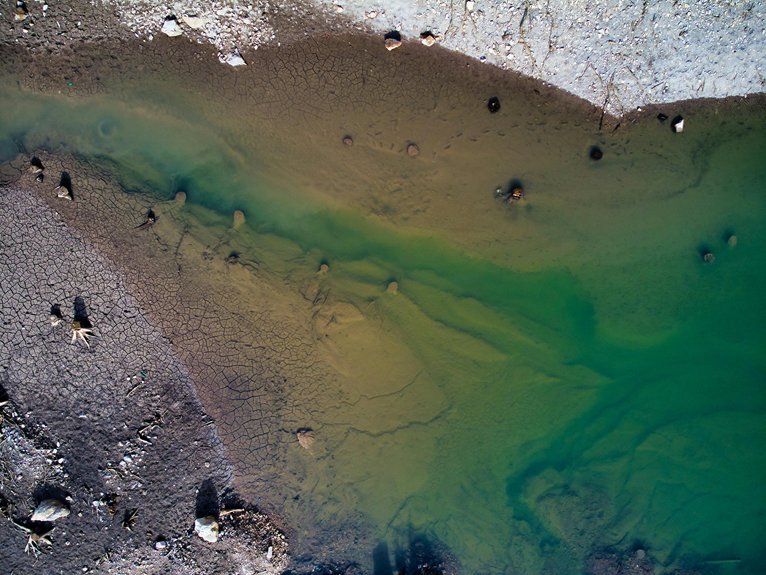
Sediment acts like a nutrient bank because it can adsorb, store, and gradually release nutrients such as nitrogen and phosphorus. Fine particles like clay and organic matter provide extensive surface area and reactive sites for nutrients to bind. Mineral composition, layering, and chemical properties influence this capacity. As a result, sediments regulate nutrient availability, help prevent excess runoff, and support aquatic ecosystems. Exploring these processes reveals how sediments contribute to water quality and ecosystem health in more detail.
Key Takeaways
- Fine sediments with high surface area and mineralogy provide abundant reactive sites for nutrient adsorption.
- Clay minerals and iron/aluminum oxides in sediments enhance their capacity to bind nutrients like nitrogen and phosphorus.
- Organic matter within sediments creates functional groups that attract and retain nutrients effectively.
- Sediment layering and composition enable nutrients to settle, concentrate, and be stored over time.
- Physical and chemical interactions in sediments allow them to trap, stabilize, and gradually release nutrients, acting as a nutrient reservoir.
What Is Sediment and How Does It Form in Waterways?
What is sediment, and how does it develop within waterways? Sediment comprises particles of mineral, organic, and inorganic material that originate from various sources. Its composition varies depending on the surrounding geology, land use, and biological activity in the area.
Sediment develops through the process of sediment transport, where particles are eroded from the land and carried by water currents. This movement can occur via several mechanisms, including suspension, bedload, or dissolved transport, depending on the particle size and flow velocity.
As water flows through rivers, lakes, and streams, it continuously deposits and re-suspends sediment, influencing the aquatic environment. Over time, deposited sediments accumulate, forming layers that can trap nutrients or alter water chemistry.
Understanding sediment composition and transport dynamics is essential for evaluating its role as a nutrient bank, as these processes determine how nutrients are stored and released within water bodies.
How Does Sediment Trap Nutrients Like Nitrogen and Phosphorus?
Sediment’s ability to trap nutrients depends on its composition and surface properties. Nutrient adsorption occurs through specific chemical interactions and physical binding mechanisms within the sediment matrix. These processes influence how nitrogen and phosphorus are retained and released in aquatic environments. Understanding biological water treatment plays a crucial role in managing nutrient levels and improving overall water quality.
Sediment Composition and Composition
How does sediment effectively trap nutrients such as nitrogen and phosphorus? Sediment mineralogy plays a vital role, as mineral types influence nutrient binding capacity.
Fine-grained sediments, rich in clay minerals, provide extensive surface areas conducive to nutrient retention. Sediment layering further enhances nutrient trapping by creating stratified zones where nutrients can settle and become concentrated over time.
These layers often consist of organic matter, mineral particles, and biological debris, which collectively influence the sediment’s chemical properties. The mineral composition determines the sediment’s ability to adsorb and stabilize nutrients, preventing their immediate release into water columns.
Consequently, the specific mineralogy and layering patterns of sediment contribute markedly to its capacity to act as a nutrient reservoir within aquatic environments.
Nutrient Adsorption Processes
Nutrient adsorption processes are fundamental to the sediment’s role as a nutrient reservoir in aquatic systems. Sediment mineralogy influences the capacity for nutrient retention, with clay minerals and iron and aluminum oxides providing surfaces for adsorption.
Organic matter interactions also play a pivotal role, as decomposing organic material creates reactive sites and releases functional groups that attract nutrients like nitrogen and phosphorus. These interactions facilitate the temporary sequestration of nutrients, preventing immediate loss through water flow.
The affinity of sediments for specific nutrients depends on mineral composition, pH, and organic content, which determine the strength and stability of adsorption. Consequently, sediment acts as a dynamic nutrient sink, modulating nutrient availability and cycling within aquatic environments.
Sediment-Binding Mechanisms
What mechanisms enable sediments to effectively trap nutrients such as nitrogen and phosphorus? Sediment-binding mechanisms rely on physical and chemical interactions that facilitate nutrient retention during sediment erosion and transport. Fine particles, such as clay and organic matter, provide surfaces with high adsorption capacity, capturing nutrients as sediments move downstream.
Additionally, sediment erosion exposes mineral surfaces and organic compounds that bind nutrients, preventing their immediate loss. During sediment transport, nutrients can become incorporated into the sediment matrix or adsorbed onto particle surfaces, effectively acting as a nutrient reservoir.
These mechanisms are influenced by sediment composition, particle size, and chemical conditions, all of which enhance the sediment’s ability to act as a nutrient bank by trapping nitrogen and phosphorus during erosional processes.
How Does Sediment Support Aquatic Plants and Animals?
Sediment plays a fundamental role in sustaining aquatic ecosystems by providing essential resources for plants and animals. The sediment composition, including organic matter, minerals, and fine particles, creates a habitat that supports diverse organisms.
Nutrient cycling within sediments replenishes essential elements like nitrogen and phosphorus, making them available for aquatic plants. These plants, such as submerged grasses and algae, rely on nutrients released from sediments to grow and photosynthesize.
Additionally, benthic invertebrates burrow through sediments, aiding oxygen penetration and nutrient distribution, which benefits larger aquatic life. Sediments also serve as a nursery for juvenile fish and invertebrates, offering shelter and feeding grounds.
The continuous exchange of nutrients between sediments and overlying water maintains ecosystem productivity. Consequently, sediment acts as a key nutrient reservoir, supporting the food web and overall health of aquatic ecosystems through sustained nutrient cycling and habitat provision.
What Factors Influence Sediment’s Ability to Store Nutrients?
The capacity of sediment to store nutrients depends on a variety of physical, chemical, and biological factors that influence its composition and interactions within the aquatic environment. Sediment chemistry plays a central role, as elements such as organic matter, mineral content, and pH levels affect nutrient binding and release.
Organic-rich sediments tend to hold nutrients more effectively due to microbial activity and the formation of stable compounds. Sediment layering also influences nutrient storage; deeper layers often contain older, more stabilized nutrients, while surface layers are more dynamic and responsive to environmental changes.
The degree of compaction and grain size impact porosity and permeability, affecting how nutrients are retained or transported. Biological activity, including microbial processes and benthic organisms, further modulates nutrient cycling within different sediment layers.
Collectively, these factors determine the sediment’s ability to act as a nutrient reservoir and influence nutrient availability within aquatic ecosystems.
How Does Sediment Accumulation Impact Water Quality and Ecosystem Health?
Accumulation of sediment in aquatic environments can considerably influence water quality and ecosystem health by altering physical, chemical, and biological processes. Sediment diversity, which includes a range of particle sizes and compositions, affects light penetration, nutrient availability, and habitat structure.
High sediment transport rates can lead to increased sediment deposition, reducing water clarity and disrupting photosynthesis in aquatic plants. Excess sediment often carries pollutants, such as nutrients and toxins, further degrading water quality.
Sediment accumulation can smother benthic habitats, impairing the organisms that depend on them. This process can also modify flow patterns, potentially causing erosion or sediment build-up in critical zones.
Overall, these changes threaten aquatic biodiversity and ecosystem stability. The dynamic nature of sediment transport plays a central role in these impacts, influencing both short-term conditions and long-term ecological resilience.
Understanding these effects is essential for effective water resource management and conservation efforts.
What’s the Difference Between Fine and Coarse Sediments for Nutrient Storage?
Fine sediments have a higher surface area relative to their volume, enhancing their capacity to bind nutrients.
Coarse sediments, with larger particle sizes, generally exhibit lower binding capacity but permit faster sedimentation.
These differences influence nutrient retention efficiency and the overall role of sediments as nutrient reservoirs.
Particle Size and Surface Area
Particle size substantially influences the capacity of sediments to store nutrients, with surface area playing a crucial role in this process. Finer particles, such as clay and silt, have a larger surface area relative to their volume compared to coarser sediments like sand.
This increased surface area enhances the ability of fine particles to adsorb and retain nutrients, making them highly effective nutrient banks. Conversely, coarse sediments with smaller surface areas provide fewer sites for nutrient binding.
The relationship between particle size and surface area determines how efficiently sediments can act as reservoirs for nutrients, affecting nutrient availability and cycling within aquatic ecosystems. Therefore, the finer the sediment, the greater its potential to serve as a nutrient bank due to increased surface area.
Binding Capacity of Sediments
How does sediment texture influence its capacity to store nutrients? Fine sediments generally have a higher binding capacity due to their increased surface area and specific sediment mineralogy, which promotes adsorption of nutrients.
Coarse sediments, with larger particle sizes, offer less surface area and fewer reactive sites for nutrient binding. Sediment mineralogy also plays a critical role; clay minerals and organic compounds in fine sediments provide binding sites that enhance nutrient retention.
Additionally, sediment layering affects nutrient availability, as finer layers tend to trap nutrients more effectively than coarser ones. Overall, the combination of particle size, mineralogy, and layering determines the sediment’s ability to act as a nutrient reservoir, with fine, layered sediments offering superior binding capacity compared to their coarser counterparts.
Nutrient Retention Efficiency
The efficiency of nutrient retention in sediments varies considerably between fine and coarse types, primarily due to differences in surface area and mineral composition. Fine sediments possess a greater surface area, enhancing their capacity to adsorb nutrients through mineralogical interactions, especially within diverse sediment layering.
Sediment mineralogy influences nutrient binding strength, with clay-rich layers offering higher retention due to their reactive mineral surfaces. Coarse sediments, with larger particles and less surface area, exhibit lower nutrient retention efficiency, often resulting in quicker nutrient release.
Sediment layering determines nutrient accessibility, where finer layers trap nutrients more effectively, while coarser layers facilitate faster nutrient exchange. Overall, the interplay between mineralogy and layering critically governs the retention efficiency of sediments as nutrient reservoirs.
How Do Human Activities Affect Sediment and Nutrient Dynamics?
Human activities considerably influence the movement and distribution of sediments and nutrients within aquatic systems. Land use changes, such as agriculture, urbanization, and deforestation, often increase sediment transport and sediment erosion. Construction projects disturb soil stability, leading to heightened sediment runoff into water bodies.
This accelerated sediment transport affects nutrient dynamics by delivering excessive nutrients from disturbed soils into aquatic environments, often causing eutrophication. Agricultural practices involving fertilization can amplify nutrient loading, further altering sediment and nutrient interactions.
Deforestation reduces vegetation cover that stabilizes soil, increasing erosion rates and subsequent sediment and nutrient delivery downstream. Urban stormwater runoff carries sediments enriched with nutrients from impervious surfaces, intensifying the sediment and nutrient flux.
These human-induced changes can disrupt natural sediment cycling, enhance sedimentation rates, and lead to imbalanced nutrient distribution, ultimately impacting aquatic ecosystems‘ health and stability.
How Does Sediment Act as a Natural Buffer During Floods?
During flood events, sediments in riverine and floodplain environments serve as an essential natural buffer, mitigating the impact of excess water flow. Sediment stabilization reduces erosion and controls sediment transport, helping to prevent rapid downstream sedimentation that can worsen flooding.
Organic matter within sediments enhances this effect by increasing soil cohesion and stability, therefore absorbing and dispersing floodwaters more effectively. During high flow conditions, organic-rich sediments act as a sponge, temporarily holding water and slowing its movement.
This buffering capacity reduces peak flood levels and minimizes erosion of banks and floodplain areas. Additionally, stabilized sediments with abundant organic matter promote the development of cohesive, resilient riverbanks and floodplain surfaces.
These natural features act as a first line of defense, absorbing flood energy and reducing its destructive potential. Overall, sediment stabilization and organic matter play essential roles in enhancing the flood-buffering capacity of riverine systems, protecting ecosystems and human infrastructure.
How Can We Manage Sediment for Better Ecosystem and Water Quality Outcomes?
Effective management of sediment within river systems is essential for enhancing ecosystem health and maintaining water quality. Understanding sediment chemistry helps identify nutrient composition and potential pollutants, guiding targeted interventions.
Strategies such as implementing sediment retention basins, riparian buffers, and controlled land use practices can reduce excessive sediment transport downstream. Managing sediment transport involves stabilizing banks and controlling erosion to prevent unwanted sediment loads from entering water bodies.
Restoring natural flow regimes and implementing sediment trapping structures can minimize sediment disturbance and accumulation where it benefits ecosystems. Additionally, monitoring sediment dynamics allows for adaptive management, ensuring interventions remain effective over time.
Proper sediment management helps prevent nutrient overloads that can lead to algal blooms and hypoxia, while also promoting beneficial sediment deposition that sustains aquatic habitats. Collectively, these practices support healthier aquatic ecosystems and improved water quality by balancing sediment input and retention.
Conclusion
Sediment functions as a natural nutrient bank by trapping and storing essential nutrients like nitrogen and phosphorus, supporting aquatic life, and buffering ecosystems during environmental fluctuations. Its composition and accumulation are influenced by natural processes and human activities, impacting water quality and ecosystem health. Proper management of sediment dynamics can enhance water clarity, reduce pollution, and promote sustainable aquatic habitats. To schedule your initial water management consultation, visit us online at Clean Flo. This highlights sediment’s crucial role in maintaining healthy and resilient waterways.